Showing posts with label Alan Barnes. Show all posts

10 September 2020

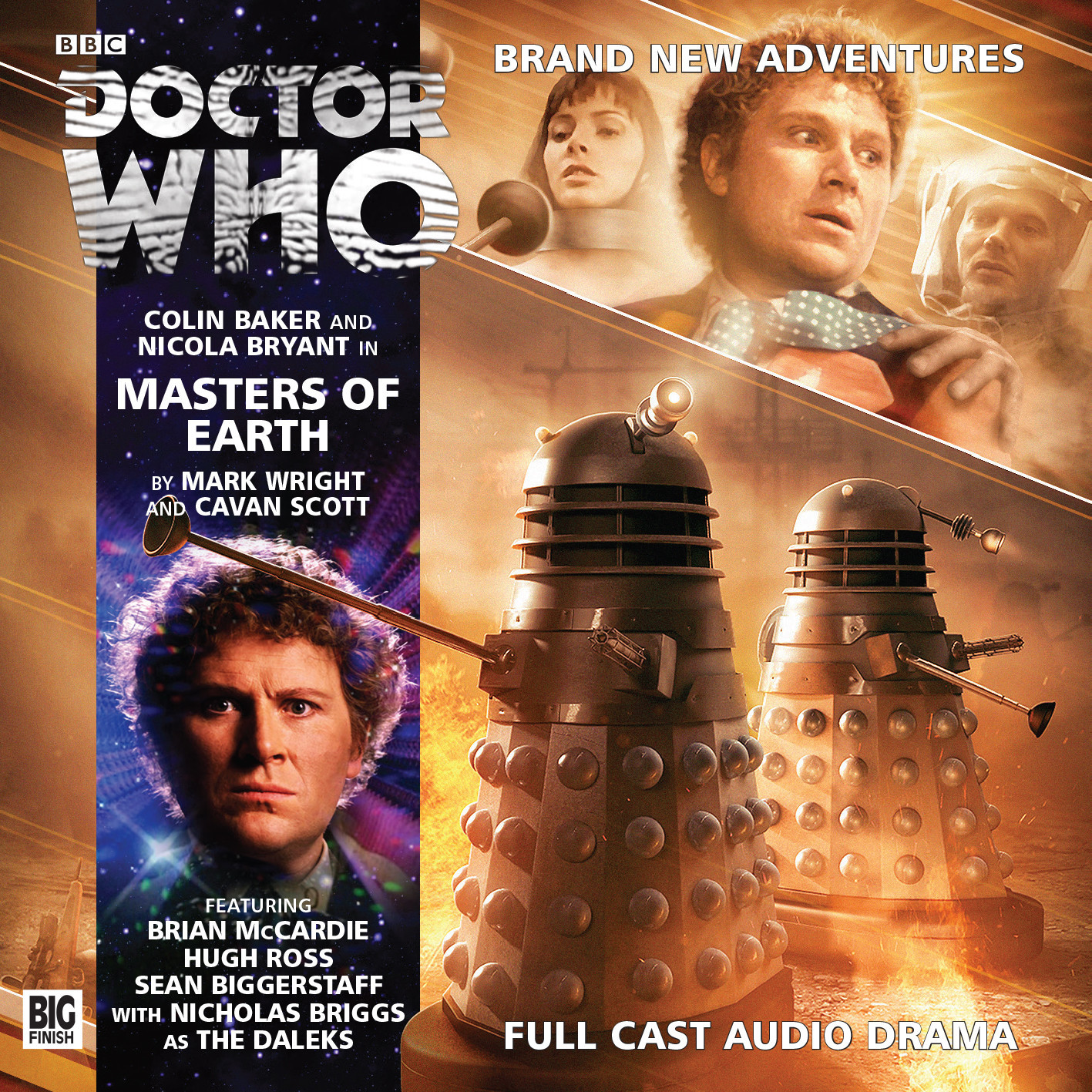
Doctor Who: Masters of Earth

Writers: Mark Wright & Cavan Scott
Director: Nicholas Briggs
Script Editor: Alan Barnes
Cover Illustration: Anthony Lamb
Music: Nicholas Briggs
Sound Design: Martin Montague
Producer: David Richardson

Starring Colin Baker & Nicola Bryant
Released October 2014

The most remarkable thing about Masters of Earth is how much of a melting pot of stock Terry Nation plots it is: obviously Daleks and another visit during their invasion of Earth, but there's duplicates, Varga plants, trans-solar discs, double-crossings galore, a secluded community with its own system of justice and a mysterious island that you have to cross dangerous waters to reach. Mark Wright and Cavan Scott embellish these with a few short-lived innovations of their own but at its heart this story is trying its hardest to be the ultimate Dalek story. Unfortunately it comes up short.


After their fractured reunion in The Widow's Assassin, the Doctor and Peri of Masters of Earth are indistinguishable from the characters at any other point in their history. There are a small number of token lines like "it's been such a long time" or "how I missed you" sprinkled throughout, but they could quite happily be cut and the rest of the story would be unaffected. It's understandable on some level: such straightforward action-adventure stories rarely dwell on luxuries such as character unless it later serves some plot function. But if that's the case, why make this the first story after they've finally found each other again? Why not change the story to fit the two central characters, rather than carrying them through a narrative they are bound not to interfere with? We've seen that it's possible to tell a Dalek story that is affecting on a personal level. Something along those lines might have had much more of an impact than this rerun of The Dalek Invasion of Earth.


The story begins, as you might expect, with the Doctor and Peri cut off from the TARDIS, meeting a subjugated community and then being carted off by the Daleks. The twist here is that they've landed at least a year before the first Doctor and co in the 1964 TV story, meaning the Doctor is bound from getting involved in case he disrupts what has already happened. Lucky it's the shy and retiring sixth Doctor on hand, not known for ruffling feathers. Pleasingly, Masters of Earth does get to the refinery much quicker than it took to reach the mine on TV, but it turns out to be completely inconsequential to the plot anyway. The bulk of the adventure is actually relatively Dalek-free, instead foregrounding their more gruesome creations - Robomen, Varga plants and Slythers - and taking place on the aforementioned island, and the journey to it.


Masters of Earth is fine scene-to-scene but completely unchallenging and almost entirely forgettable. Even the writers' invention of a higher tier of Robomen, and the reason why they are quickly dispensed with, feels a bit like clutching at straws to add yet more to an already overlong story. It's hard to believe that if Big Finish wanted an unapologetic sequel to a sixties Dalek story set entirely in Scotland nowadays, it wouldn't be Andrew Smith getting the call. And the execution is uncannily similar to how Smith might have dealt with the brief. Colin Baker and Nicola Bryant are unfazed by the shallow material and get almost exactly zero opportunities to showcase how their characters have developed in the years since they were last together. The Doctor is also more callous and closer to his Season 22 personality than we've seen in a while, taking his character in the exact opposite direction to what the listener might expect. Kyle Inskip, easily the best original character in this thanks to yet another winning performance from Hugh Ross, has his prized motorbike stolen and dumped by the Doctor after offering him refuge, and then spends the rest of the story hauling the TARDIS out the swamp. His thanks? A box of knock-off whisky that the Doctor says is foul. We can only hope the Doctor snaps out of this mood soon.


While the script is slavishly adherent to sixties conventions, the production of this story is not. The Dalek voices sound far too modern and the mechanical, electrical sound effects are a far cry from the creaks and thumps of their 1964 counterparts. I realise that since this is an audio drama more work has to be done but there must surely have been some middle ground of this. The sound design is otherwise excellent, especially for a script that demands the inclusion of so many different dialogue-free horrors. The music is another matter however. Frequently out of place, missing the point in scenes and breaking any immersion the listener might've managed to work up, its inclusion is arguably to the detriment of the story. One thing that can be said is that it is at least authentic, sometimes too authentic. I hope Roger Limb's royalties aren't too steep. A soundtrack with a sparser, more sixties feel would have been welcome but at least it's not too far a cry from what we might've got had this been on TV in the mid-eighties.


Masters of Earth is not actively bad but we've heard it all before and it's somehow still less than the sum of its well-worn parts. Shockingly for their first trip back together, you could skip this story without missing any of the Doctor/Peri storyline. This is a massive oversight on the part of the script editor and huge potential squandered. To think a story that really gets under the skin of these two characters was sacrificed for this Saturday afternoon shallow adventure tale only sours the impression Masters of Earth leaves. So what if it's Peri's first Dalek story on audio? Nothing is made of this - in fact it took quite a bit of effort to check this was actually the case. In case the listener was in any doubt there'd be another one along in a minute, Bryant has only had one trilogy since this and, oh look, there's another Dalek story. In the same way, the concept of there being disastrous consequences if the Doctor gets involved in any way goes out the window almost instantly, flattening the only real hook this story had.


Despite its incredible 140-minute length, Masters of Earth is another inconsequential set piece-based adventure narrative that goes in a big loop. Fine but far from essential.

09 September 2020

Doctor Who: Come Die With Me

Writer: Jamie Anderson
Director: Ken Bentley
Script Editor: Alan Barnes
Cover Illustration: Joseph Bell
Music & Sound Design: Steve Foxon
Producer: David Richardson

Starring Sylvester McCoy & Sophie Aldred
Released December 2015
Come Die With Me marks the halfway point of the You Are The Doctor anthology and, so far, it looks to be one of the most disposable releases yet. Jamie Anderson's story of an old-fashioned mansion in the future seems to be desperately trying to create a Night Thoughts-style atmosphere, but ends up closer to The Silurian Candidate.

The setup initially seems to be a murder mystery game organised by the skin-crawling Edwin Norris that has stumped the greatest minds from all time and space. This naturally piques the Doctor's curiosity, while Ace is pulled below stairs with the housekeeper. They learn more about the situation in tandem and eventually the Doctor must save Ace and defeat Norris. It's not especially challenging stuff, which isn't a problem in itself, but this is so chaotic it's hard to get a handle on anything and hence hard to pay attention.

There is something in Anderson's story of a murder mystery in an old house with the Sylvester McCoy Doctor that evokes stories like Master and The Magic Mousetrap. Unfortunately, that is where comparisons to these two superior releases end. Control of knowledge seems to be the 'theme' of this anthology so far, unless you count Ace having a go at flying the TARDIS, which still wouldn't be the flimsiest arc Big Finish have attempted. In Come Die With Me's climactic scene, Norris ends up giving McCoy a run for his money in the gurning and histrionics stakes, revealing that he wants to trap the minds of anyone in creation more intelligent than him in his library so that he can be the cleverest being in history. On the strength of the 20 minutes preceding this, he's going to need a bigger library.

So much care goes into crafting these stories in post-production that it seems ungrateful to criticise. There must be nightmares on so many productions that the listeners never discover because of talented sound designers managing to save them. But still, the presentation of Come Die With Me leaves a lot to be desired. This can be laid at the door of director Ken Bentley; McCoy gives a shocking performance, vamping it up like a good 'un on what appears to be his first encounter with the script. Sophie Aldred as Ace isn't much better, sounding like she got out the wrong side of bed and going massively over the top on almost every line. The sound design completely misses every open goal with regards to building atmosphere, and instead goes gives the impression of stock tracks for an am dram matinee. The music is also far too lightweight and completes the impression that the production team see this as disposable fluff, and consequently that's what they have made.

It is entirely reasonable to skip Come Die With Me without missing anything in character, plot or production terms. When people are paying £15 for this release that is inexcusable. At least You Are The Doctor was trying something different; it speaks volumes that the actor playing Norris isn't even credited.

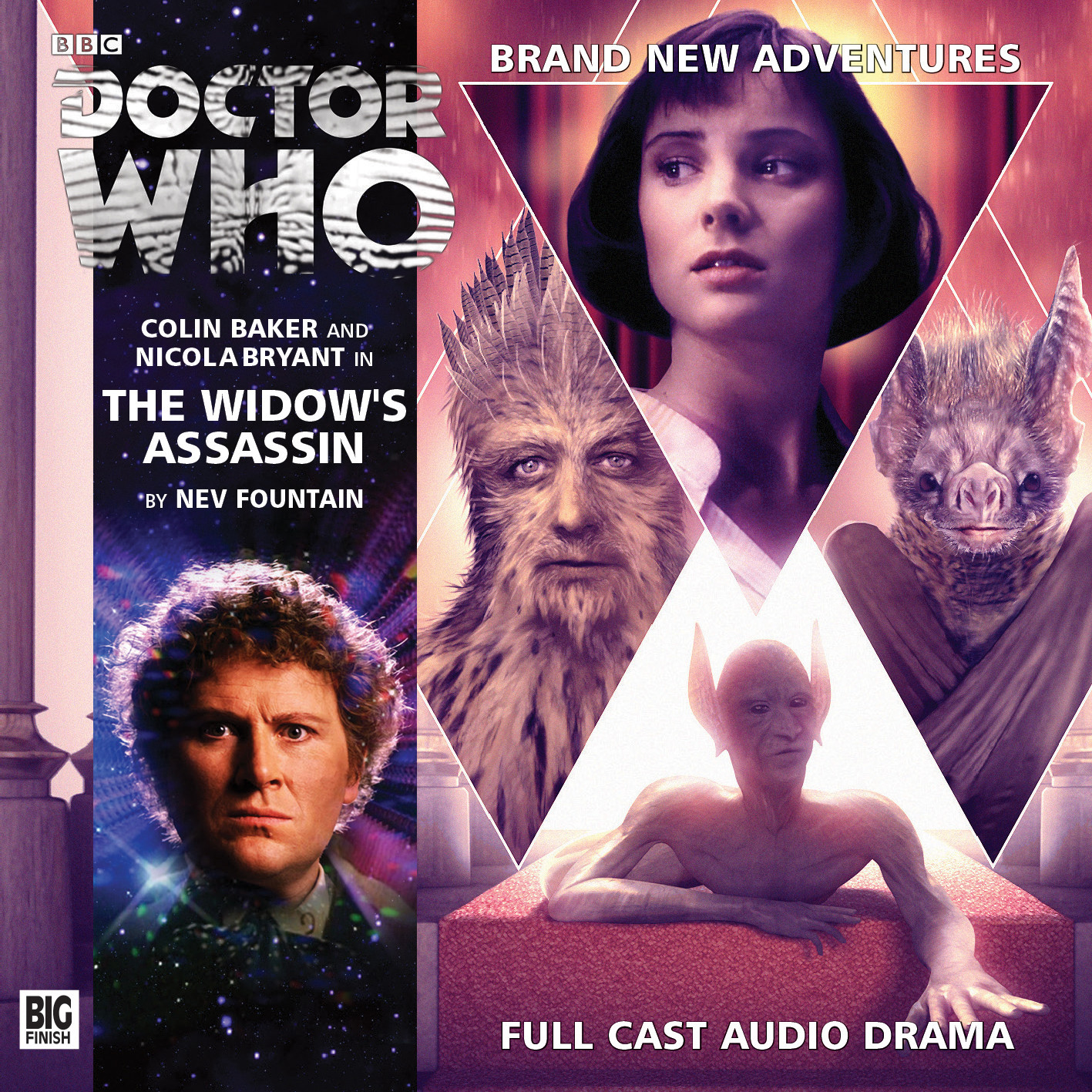
Doctor Who: The Widow's Assassin

Writer: Nev Fountain
Director: Ken Bentley
Script Editor: Alan Barnes
Cover Illustration: Anthony Lamb
Music: Howard Carter
Sound Design: Steve Foxon
Producer: David Richardson

Starring Colin Baker & Nicola Bryant
Released October 2014

The Widow's Assassin sees writer Nev Fountain at his most unpredictable, which is quite achievement. Across its four episodes, the listener is taken on a journey through a fairy tale made flesh, royal court intrigue, battles inside multiple minds and home in time for tea. That this is accomplished with such style is a credit to Fountain and director Ken Bentley.


Following the end of Scavenger, in which the sixth Doctor's latest tagalong Flip (Lisa Greenwood) departed seemingly definitively, he turns up on Krontep in search of reconciliation with Peri (Nicola Bryant), following their own fractious parting. Familiarity with the 1986 Doctor Who TV story Mindwarp benefits the listener a surprisingly great deal when listening to The Widow's Assassin. No sooner has Fountain finally married Peri and King Yrcarnos (Brian Blessed, on TV) than he's done away with him, and this is the catalyst for the rest of the story. Maybe catalyst is the wrong word, as the first episode alone is audacious enough to take place over the course of five years - and then the second goes one better and doubles it.


Setting the story over such a long period allows Fountain to establish and pay off some of the Doctor/Peri relationship work he is famed for. The irony is that, in the end, barely any time at all has passed for Peri, compared to decades for the Doctor. Ordinarily stories that concern themselves with, to paraphrase The Androids of Tara, the affairs of a piffling little planet, hold little interest. But Nev Fountain's colourful universe of characters really makes this story stand out from the crowd. Most notable is Constable Wolsey, Peri's head of security and also half-man/half-sheep. In fact, it is Wolsey who carries the story's first half, narrating events and taking the lead in the second episode. The Doctor's absence here creates a noticeable void, Fountain's writing creating questions in the listener's mind. What he has been up to is more than anyone would expect.


The Widow's Assassin skillfully walks the line between being intelligent and impregnable. Something this high-concept could have made for a difficult listen, especially at its extended length, and especially given it is such a hardcore sequel to Mindwarp. Ken Bentley, the cast and the post-production succeed in making this extremely listenable and realising the script's considerable ambition. The music in particular is to be commended for completing such a rounded production.


As a scene-setter for a new era of travels for Colin Baker and Nicola Bryant, The Widow's Assassin functions perfectly. While it is not a flawless script - the reappearance of the Doctor's first ever foe that comes to nothing is perhaps one subplot too far - the relationship of the Doctor and Peri, characters thirty years in the making is at its core and on this Fountain, Baker and Bryant never put a foot wrong. It is refreshing to have a story as genuinely witty, in writing and execution, as this and it is an absorbing listen, particularly the first two episodes. A triumph for all involved, setting the bar high and leaving the listener hungry for the next story.

06 August 2020

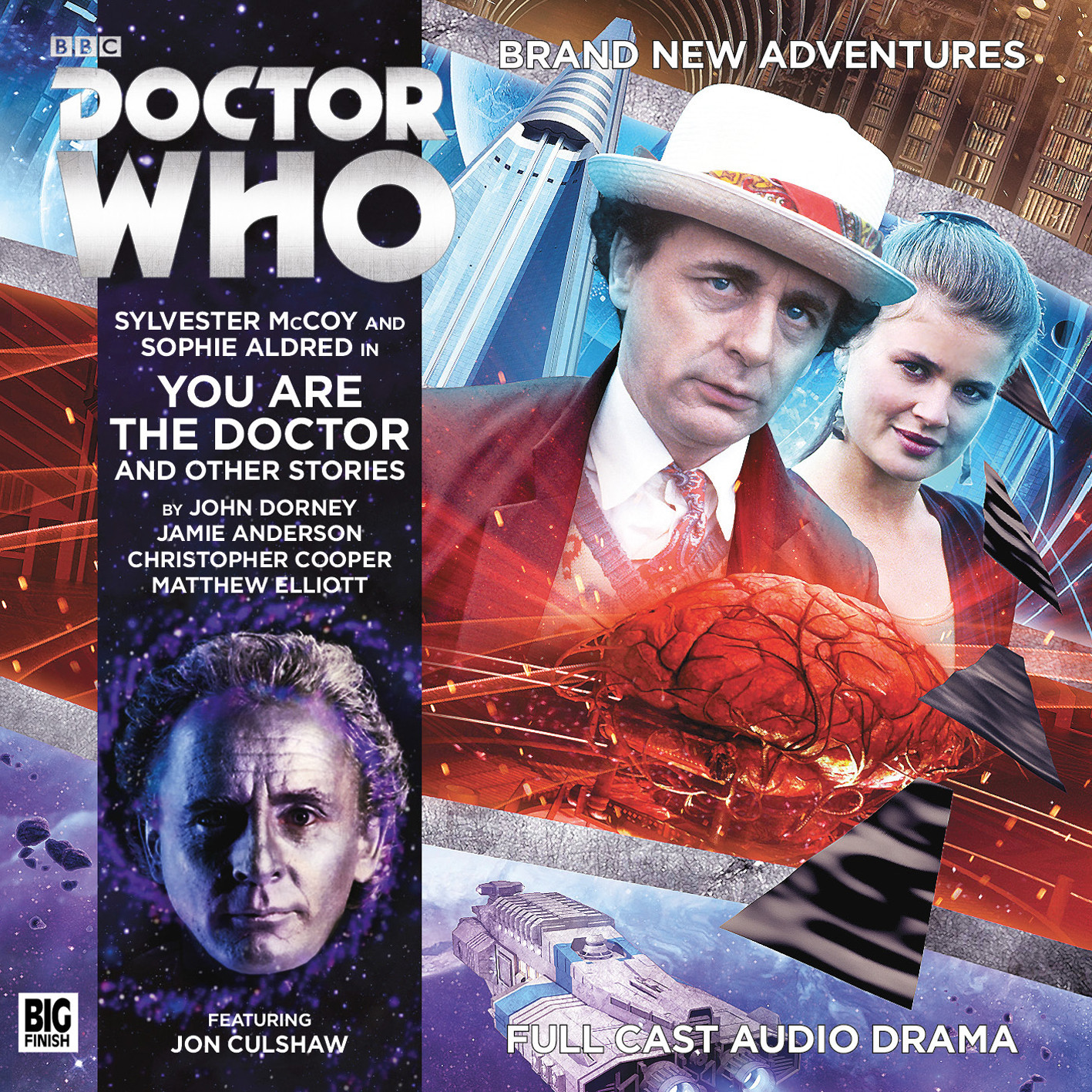
Doctor Who: You Are The Doctor

Writer: John Dorney
Director: Ken Bentley
Script Editor: Alan Barnes
Cover Illustration: Joseph Bell
Music & Sound Design: Steve Foxon
Producer: David Richardson

Starring Sylvester McCoy & Sophie Aldred
Released December 2015
Opening a quartet of stories starring Sylvester McCoy and Sophie Aldred as the seventh Doctor and Ace, You Are The Doctor is an entertaining, if not outstanding, way to fill 25 minutes. Any innovation it exhibits is in its novel presentation, the plot itself being as rote as they come. The 'decide your destiny'-style narrative and the accompanying commentary at each fork in the road are used to good effect and fill the run time well enough without pushing any boundaries.

It could be said that You Are The Doctor is somewhat obvious, but then that does seem to be the point. The pig-like Porcians return from author John Dorney's own The Fourth Wall, a full-length main range story featuring Colin Baker and Lisa Greenwood. This time it appears the Doctor's old adversary Chimbly and his wife Keith have actually, against all odds, managed to invade and take over a planet, so the Time Lord's suspicions are immediately aroused.

What follows is an inoffensive jaunt through their spaceship, punctuated by the Doctor and Ace's numerous deaths, after which the listener is instructed to return the beginning of the story. The most successful element of presenting the story in this decision-based framework is that the track numbers on the CD or in the digital album do actually correspond to the options Chimbly gives, so you could actually play along if you wanted. This is arguably unnecessary given almost all listeners will, on first pass at least, play the entire story, but this kind of attention to detail elevates the episode.

This is well-directed but it's notable how McCoy, in particular, and Aldred are able to sound so ill-prepared 30 years into playing their characters. Kim Wall returns as Chimbly and the performance suits the role though the listener could be forgiven for mistaking Wall for Nick Briggs. It really is uncanny. And try as the cast might, the Porcians still aren't as funny as the script seems to think they are. The sound design and music do a good job of setting up the narrative structure and providing extra tics to denote sections such that the listener knows what's going on before any dialogue is spoken.

You Are The Doctor was perhaps inevitable. It's pleasant enough, and sets its sights no higher than that, which is fine. While this is refreshingly unconvoluted for a Big Finish McCoy episode, we've done this story now, so hopefully the second instalment in this release will prove more substantial.

27 July 2020

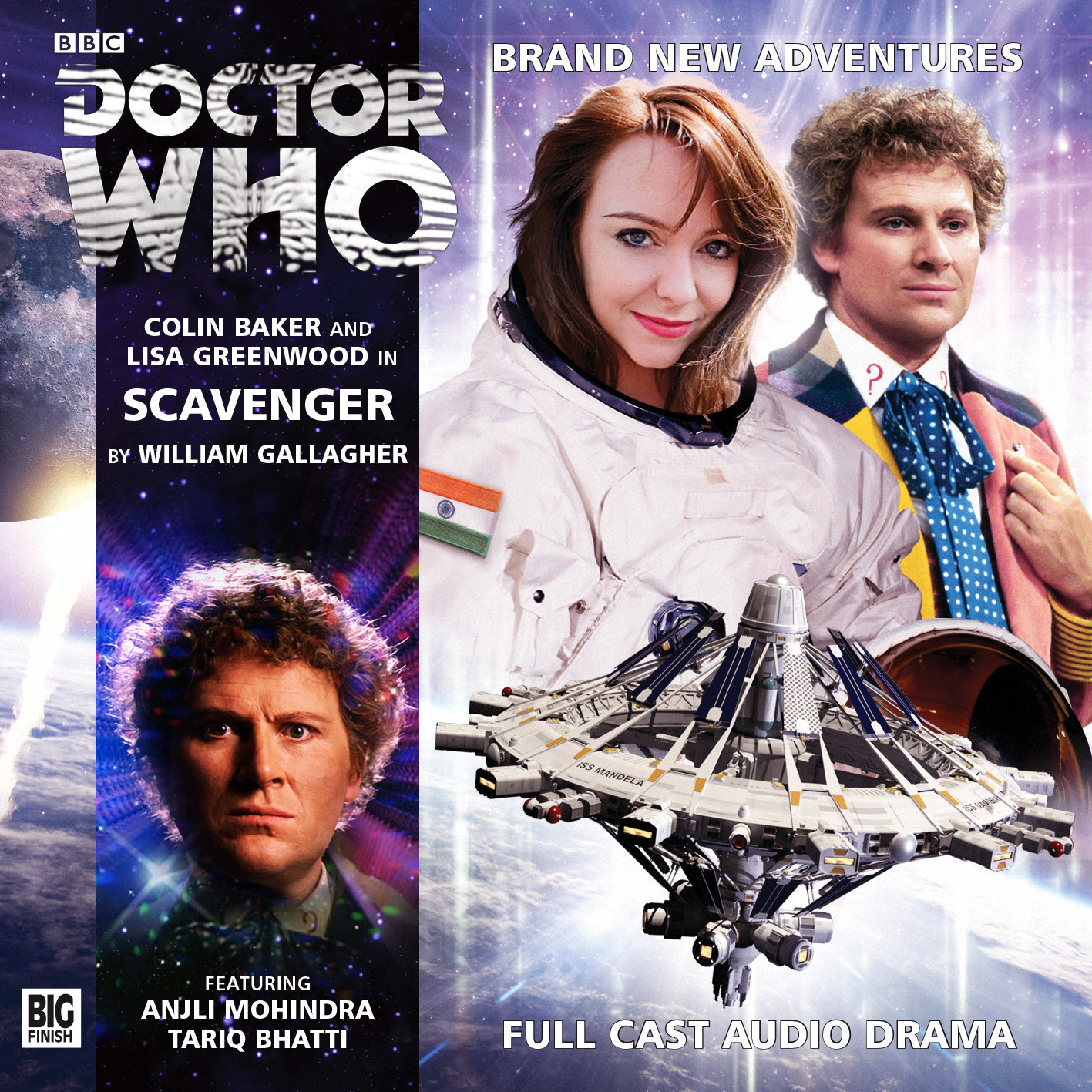
Doctor Who: Scavenger

Writer: William Gallagher
Director: Nicholas Briggs
Script Editor: Alan Barnes
Cover Illustration: Damien May
Music: Howard Carter
Sound Design: Neil Gardner
Producer: David Richardson

Starring Colin Baker & Lisa Greenwood
Released March 2014

A sense of finality hangs over Scavenger. The last in the second trilogy of releases starring Colin Baker and Lisa Greenwood, it appears to have been designed as the conclusion to a number of ongoing stories.


Principally, Scavenger foregrounds the sixth Doctor's latest accomplice Flip (Greenwood). They are separated early on, never to meet again thanks to the faith each has in the other, putting everyone else first before working their way back together. This is one of the deepest dives into Flip's character, and definitely the deepest since The Curse of Davros, her debut proper. We don't just learn about her family, but why it matters - and why it matters to her. I sense script editor Alan Barnes' guiding hand in these sections, but they are well-tempered such that they don't become an overload of information and remain relevant to the story's themes.


Scavenger is a very hardware-heavy story that begins in the near future with the launch of the Clean Up Space 2071 programme and various perspectives on it as a space craft, You Only Live Twice-style, swallows up junk lingering near Earth. This makes for an intriguing first episode and it's actually a bit of a disappointment when the titular craft shows up and the story seems to simplify with a common enemy to fight. The story also looks at the relationship between India and Britain in the near future, chiefly through the characters of mission controller Salim and obstructive bureaucrat Jessica Allaway. But India's inclusion isn't as throwaway as director Nick Briggs suggests in the interviews at the end of the story. It is embedded throughout and writer William Gallagher cleverly weaves the myth of Anarkali into the backstory of Scavenger, and uses it to drive the plot forward.


Briggs, sound designer Neil Gardner and composer Howard Carter combine to create a relentless story that, even split into four instalments, will leave you short of breath. This is well-cast, with Anjli Mohindra brilliant as Jyoti, and maintains the tension, if not always building on it, across its two hours; not an easy feat. And it seems The Widow's Assassin comes next for the sixth Doctor, a story I've been looking forward to for years.


Not unlike its namesake vessel, Scavenger demands your attention from start to finish. But it rewards in spades with easily the most competent and enjoyable story from this second Colin Baker/Lisa Greenwood trilogy. William Gallagher's sophomore story set in Earth's near future isn't as strong but his interest in the exploration of cultures and technology, and how they affect each other, remains true. A very solid script, well-realised. Can't ask for much more than that.

18 July 2020

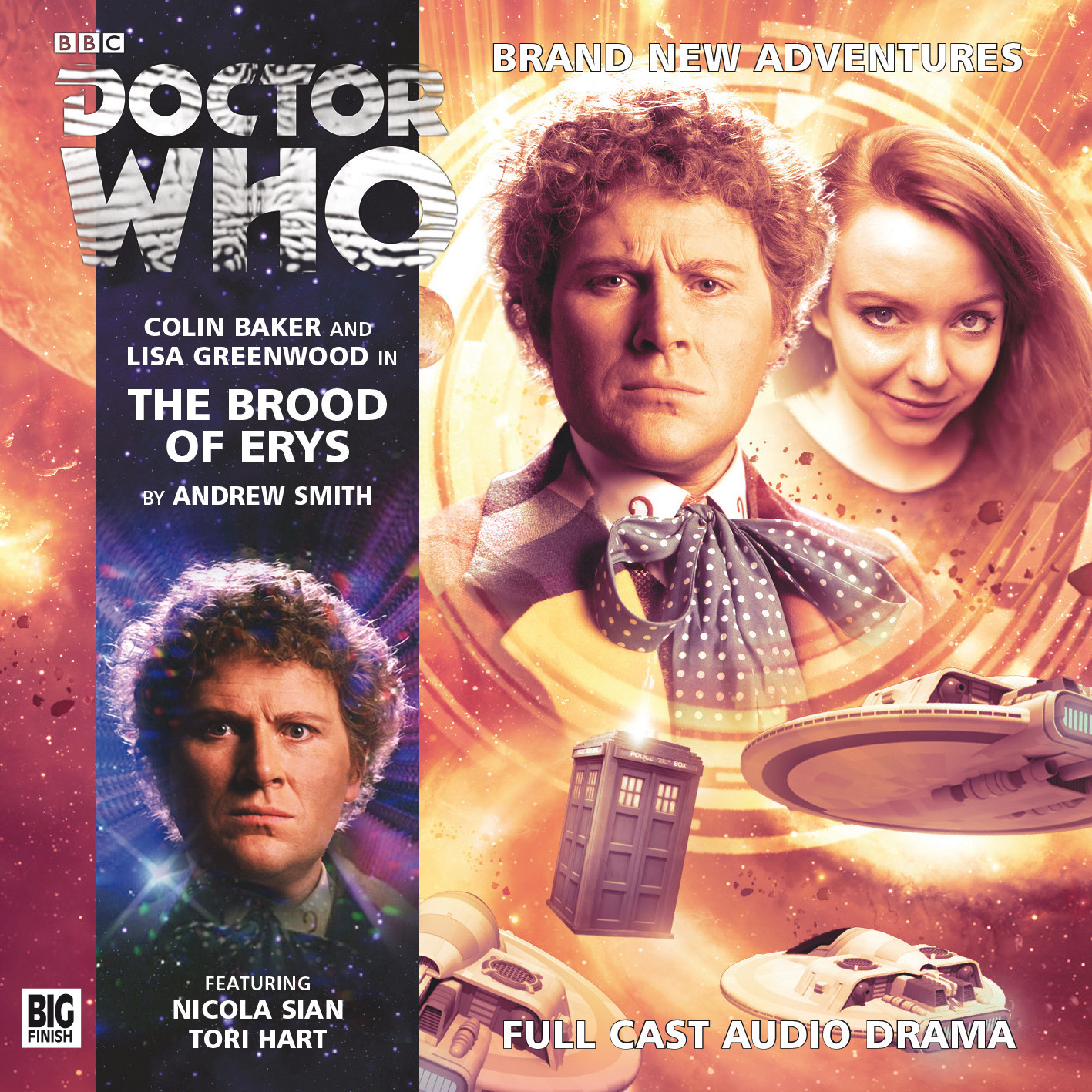
Doctor Who: The Brood of Erys

Writer: Andrew Smith
Director: Nicholas Briggs
Script Editor: Alan Barnes
Cover Illustration: Damien May
Music & Sound Design: Steve Foxon
Producer: David Richardson

Starring Colin Baker & Lisa Greenwood
Released February 2014

Big Finish's listeners are, by definition, very dedicated. Dedicated enough to seek out extra stories inspired by their favourite TV property (probably Doctor Who, let's be honest). My dedication, however, does not extend to enduring The Brood of Erys.


I had been dreading this, having first listened within a couple of years of its release, but did intend to give it another go as part of my protracted marathon of stories featuring the Sixth Doctor and Flip (Lisa Greenwood). After 25 minutes, however, I gave up. The Brood of Erys is a generic sci-fi yarn of irritating imps, babbling moons and archetypal guest characters. I am yet to be impressed, or even entertained, by an Andrew Smith script, and this fits the trend no problem.


Steve Foxon puts in a valiant effort with the sound design and music, but even casting the great Nicola Thorp in a starring role isn't enough to save this. What a waste to have two write-offs in a row for such a promising combination of Doctor and companion. Absolute rubbish.


Save your cash; life's too short.


06 July 2020

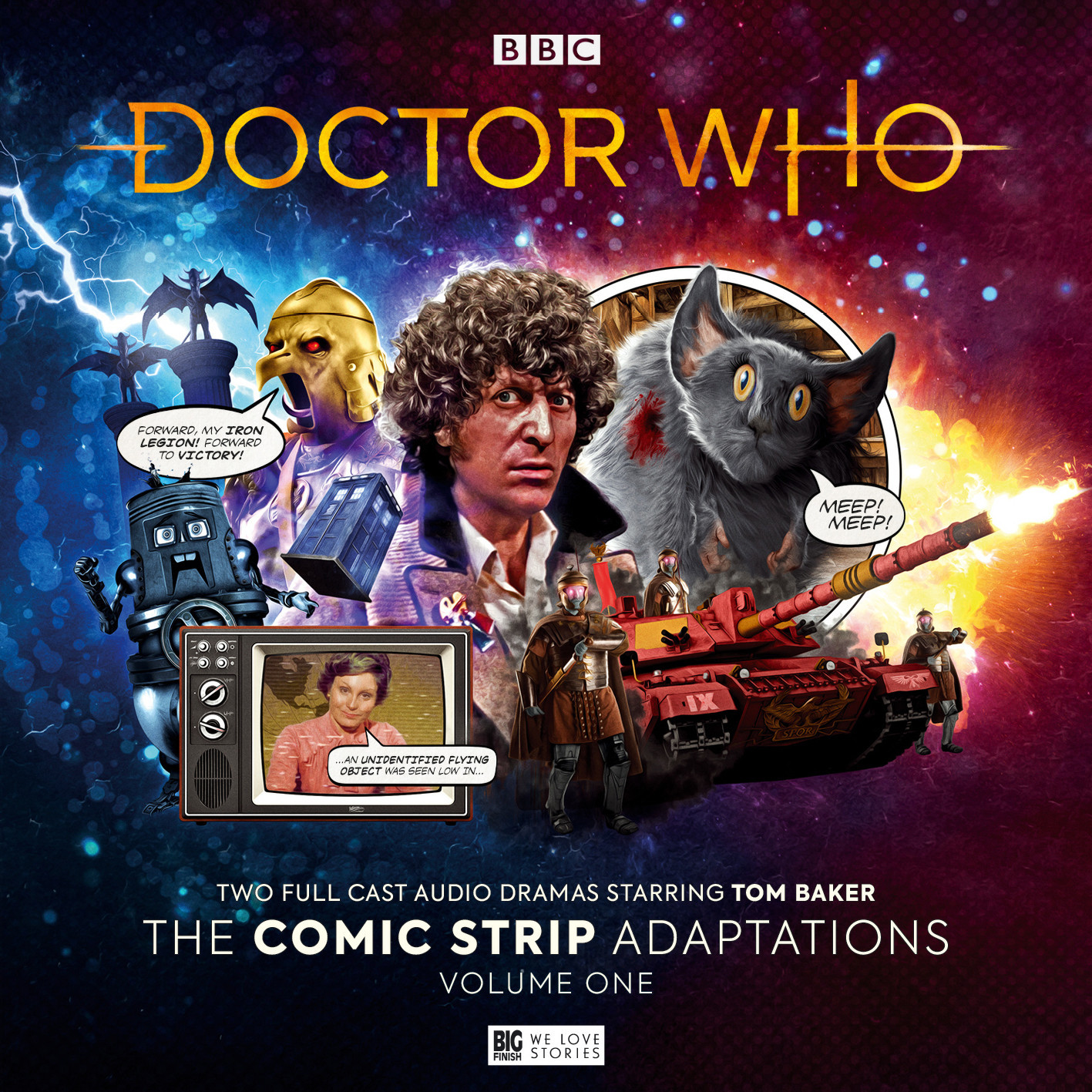
Doctor Who: The Iron Legion

Adapted by: Alan Barnes
Director: Nicholas Briggs
Script Editor: Nicholas Briggs
Cover Illustration: Will Brooks
Music & Sound Design: Alistair Lock
Producer: Jamie Anderson

Starring Tom Baker
Released March 2019
The first half of a prestige set taking comic strips published in Doctor Who Weekly's fledgling issues and turning them into full-cast audio dramas, The Iron Legion is something of a disappointment. In the year or so since its release, this story has received a swathe of glowing reviews so discovering it was quite so lacking was something of a surprise.

The basic premise is that an army of robot Roman legionaries has invaded the town of Stockbridge and after swiftly sending them packing, the Doctor follows them back through time - and, as it turns out, space. The bulk of the story takes place in Rome, 79AD, but in a parallel dimension where the empire is ruled over by a boy and aliens and robots are a fact of life. Setting The Iron Legion almost entirely in another dimension rids it of some of its mystery, as the clashing iconography is purely for its own sake, rather than there being an internal reason for interference in history. This is not exactly the end of the world, just unexpected.

The four episodes are essentially a jaunt from one outlandish character or set piece to another, and while it is a well-realised production, with a very consistent tone and strong performances (particularly Esther Hall and Joseph Kloska), the material itself is relatively unengaging. Pitched - and, to be fair, received - as a highly witty tale, The Iron Legion did seem to be wanting. The original strips were the very first published in Doctor Who Weekly in autumn 1979, spanning the broadcast of City of Death, The Creature from the Pit and Nightmare of Eden. Big Finish have experimented with the reputed Season 17 tone of wit and whimsy before, most notably with their adaptations of Gareth Roberts' nineties Missing Adventures novels (including the superb The Romance of Crime). The Iron Legion is not a patch on past efforts, although there were some aspects and additions that were very much appreciated, such as the fourth wall-breaking sound effects as we explore the Doctor's mind.

To adapter Alan Barnes' credit, as someone unfamiliar with the original story, it is hard to tell where the comic strip ends and the new material begins. But overall, this was not a particularly enjoyable experience and after the first episode, this set of eight felt like a waste of money. The story did improve, and is carried by a broad performance from Tom Baker, but ultimately it inspires no urgency to listen to The Star Beast, the other story of the set.

22 June 2020

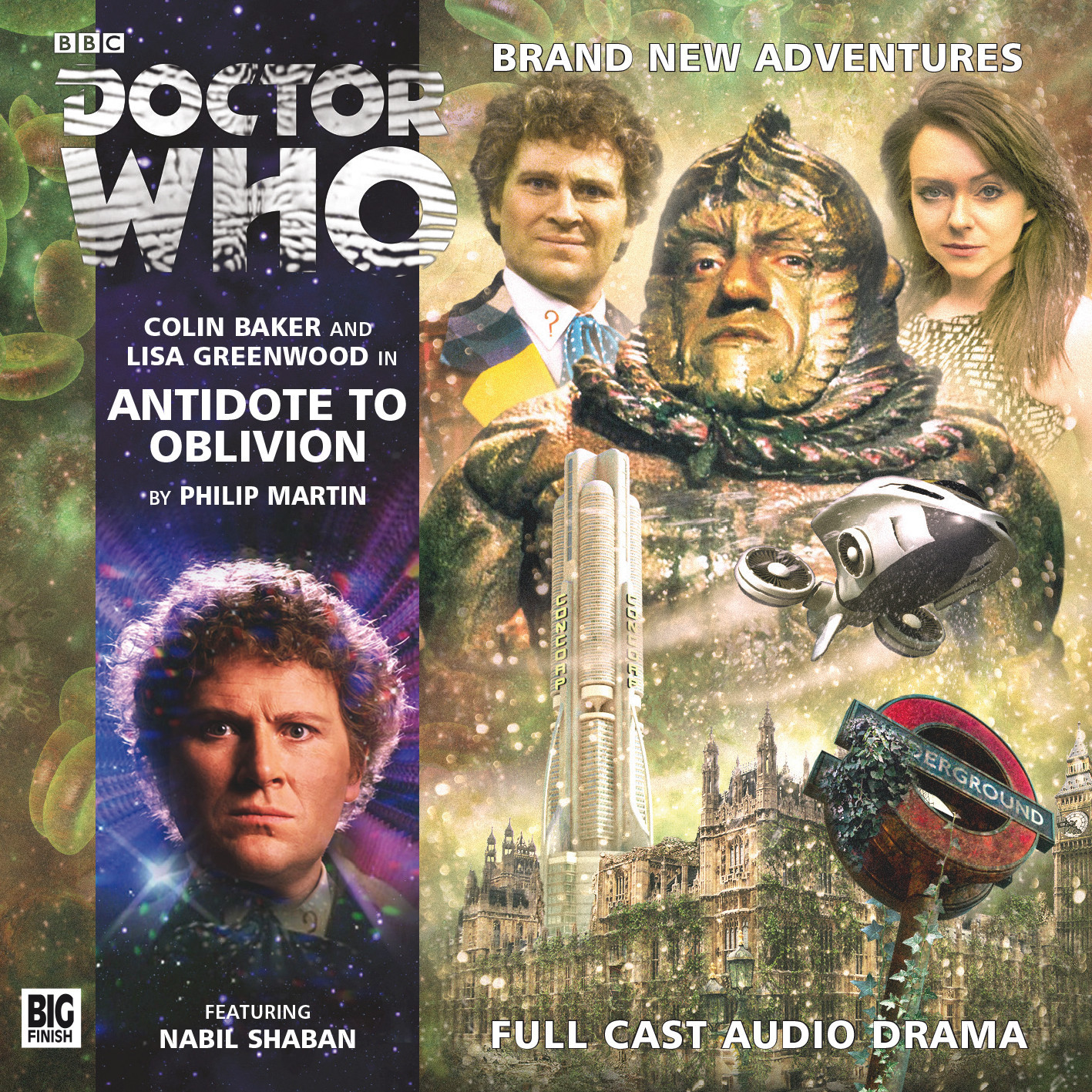
Doctor Who: Antidote to Oblivion

Writer: Philip Martin
Director: Nicholas Briggs
Script Editor: Alan Barnes
Cover Illustration: Damien May
Music & Sound Design: Fool Circle Productions
Producer: David Richardson

Starring Colin Baker & Lisa Greenwood
Released January 2014

The opening of this new trilogy of Doctor Who audios from Big Finish Productions sees Flip (Lisa Greenwood) having to drag Colin Baker's sixth Doctor away from a well-deserved rest and into the story practically kicking and screaming. Frankly he would've been better off staying put.


A shallow look at a future Earth that doesn't offer half the intrigue or nuance of William Gallagher's Wirrn Isle, the closing story in this pairing's first trilogy, Antidote to Oblivion is a real chore to get through. With stilted dialogue where characters end every sentence with the name of whoever they were talking to and a plot with all the subtlety of a sledgehammer, this is not even popcorn fodder. 


The basic story is that a few centuries from now, Britain is no longer a country but a company, ConCorp. Faced with the problem of overpopulation, the President has enlisted the help of Sil, from TV stories Vengeance on Varos and Mindwarp, and he in turn has in tow the daughter of genetic scientist Crozier from the latter. Together, these two plan to create a virus that will wipe out 90% of the population - for a fee of course. 


This idea in itself is not irredeemable but the execution is severely lacking. The virus requires a Time Lord's DNA or something, which is how the Doctor gets roped into the matter, and this basically takes well over two hours not to happen, as we know it won't. Sidelines such as an infected water supply and a couple of vapid locals only serve to delay matters. Given this is supposedly built around a showdown between the Doctor and Sil, they have very few scenes together and most of the ones they do are just Sil showing up just when the Doctor thinks he's escaped. 


Lisa Greenwood seems more comfortable in the role of Flip but the character as written often sounds stilted and out of place. This is far from Flip's story but Greenwood still makes the most of a severely underwritten part. Nabil Shaban returns once more as the slippery Sil and almost single-handedly energises a production which is otherwise populated almost exclusively with hushed tones and lofty conversation. None of the remainder of the cast make much of an impression, though Dawn Murphy hams it up sufficiently as Crozier's daughter Cordelia that she too could have stepped straight from mid-eighties Doctor Who.


The standout performer, as ever, is Colin Baker. Accustomed to making the best of a bad lot and having long since honed his characterisation of the Doctor to his liking, he rises above the material here to keep the four long episodes listenable.


The remainder of the production is good enough, though the score is often overly grand. And it seems I can't go two minutes without Nick Briggs popping up as some lacky or other lately (often the same one by the sound of it).


Crass, protracted and above all boring, Antidote to Oblivion has little working in its favour. As a company that has perfected the art of mining fans' nostalgia, it is hardly surprising Big Finish want to bring back the only villain originated in the Colin Baker era that he faced twice. But it would seem that is not enough to hang a story on, at least when it means Philip Martin is in tow. I only listened to this again as part of my trawl through the Lisa Greenwood stories, and safe to say it was my last time.


If anyone wants the CD I'm open to offers.

Search