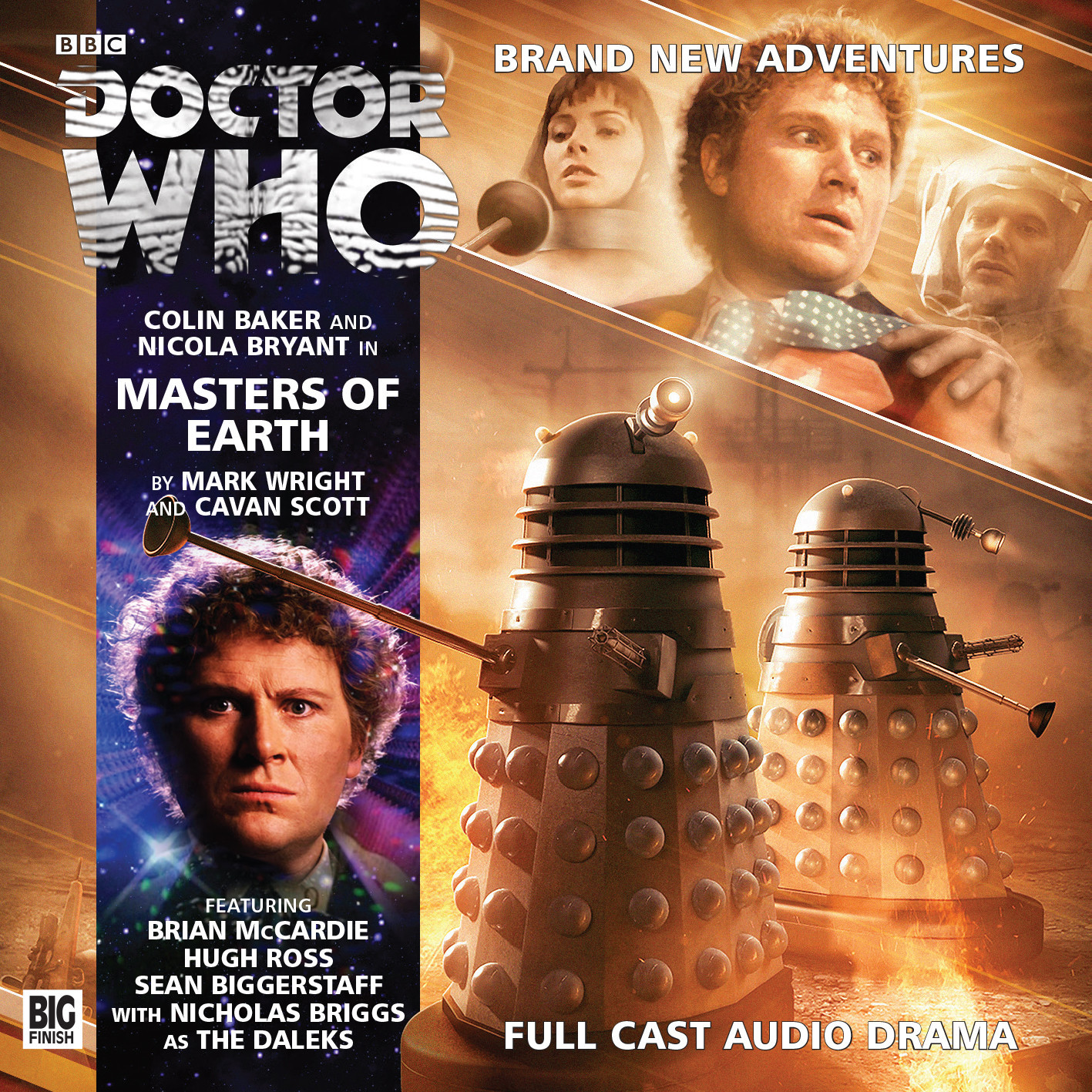
The most remarkable thing about Masters of Earth is how much of a melting pot of stock Terry Nation plots it is: obviously Daleks and another visit during their invasion of Earth, but there's duplicates, Varga plants, trans-solar discs, double-crossings galore, a secluded community with its own system of justice and a mysterious island that you have to cross dangerous waters to reach. Mark Wright and Cavan Scott embellish these with a few short-lived innovations of their own but at its heart this story is trying its hardest to be the ultimate Dalek story. Unfortunately it comes up short.
After their fractured reunion in The Widow's Assassin, the Doctor and Peri of Masters of Earth are indistinguishable from the characters at any other point in their history. There are a small number of token lines like "it's been such a long time" or "how I missed you" sprinkled throughout, but they could quite happily be cut and the rest of the story would be unaffected. It's understandable on some level: such straightforward action-adventure stories rarely dwell on luxuries such as character unless it later serves some plot function. But if that's the case, why make this the first story after they've finally found each other again? Why not change the story to fit the two central characters, rather than carrying them through a narrative they are bound not to interfere with? We've seen that it's possible to tell a Dalek story that is affecting on a personal level. Something along those lines might have had much more of an impact than this rerun of The Dalek Invasion of Earth.
The story begins, as you might expect, with the Doctor and Peri cut off from the TARDIS, meeting a subjugated community and then being carted off by the Daleks. The twist here is that they've landed at least a year before the first Doctor and co in the 1964 TV story, meaning the Doctor is bound from getting involved in case he disrupts what has already happened. Lucky it's the shy and retiring sixth Doctor on hand, not known for ruffling feathers. Pleasingly, Masters of Earth does get to the refinery much quicker than it took to reach the mine on TV, but it turns out to be completely inconsequential to the plot anyway. The bulk of the adventure is actually relatively Dalek-free, instead foregrounding their more gruesome creations - Robomen, Varga plants and Slythers - and taking place on the aforementioned island, and the journey to it.
Masters of Earth is fine scene-to-scene but completely unchallenging and almost entirely forgettable. Even the writers' invention of a higher tier of Robomen, and the reason why they are quickly dispensed with, feels a bit like clutching at straws to add yet more to an already overlong story. It's hard to believe that if Big Finish wanted an unapologetic sequel to a sixties Dalek story set entirely in Scotland nowadays, it wouldn't be Andrew Smith getting the call. And the execution is uncannily similar to how Smith might have dealt with the brief. Colin Baker and Nicola Bryant are unfazed by the shallow material and get almost exactly zero opportunities to showcase how their characters have developed in the years since they were last together. The Doctor is also more callous and closer to his Season 22 personality than we've seen in a while, taking his character in the exact opposite direction to what the listener might expect. Kyle Inskip, easily the best original character in this thanks to yet another winning performance from Hugh Ross, has his prized motorbike stolen and dumped by the Doctor after offering him refuge, and then spends the rest of the story hauling the TARDIS out the swamp. His thanks? A box of knock-off whisky that the Doctor says is foul. We can only hope the Doctor snaps out of this mood soon.
While the script is slavishly adherent to sixties conventions, the production of this story is not. The Dalek voices sound far too modern and the mechanical, electrical sound effects are a far cry from the creaks and thumps of their 1964 counterparts. I realise that since this is an audio drama more work has to be done but there must surely have been some middle ground of this. The sound design is otherwise excellent, especially for a script that demands the inclusion of so many different dialogue-free horrors. The music is another matter however. Frequently out of place, missing the point in scenes and breaking any immersion the listener might've managed to work up, its inclusion is arguably to the detriment of the story. One thing that can be said is that it is at least authentic, sometimes too authentic. I hope Roger Limb's royalties aren't too steep. A soundtrack with a sparser, more sixties feel would have been welcome but at least it's not too far a cry from what we might've got had this been on TV in the mid-eighties.
Masters of Earth is not actively bad but we've heard it all before and it's somehow still less than the sum of its well-worn parts. Shockingly for their first trip back together, you could skip this story without missing any of the Doctor/Peri storyline. This is a massive oversight on the part of the script editor and huge potential squandered. To think a story that really gets under the skin of these two characters was sacrificed for this Saturday afternoon shallow adventure tale only sours the impression Masters of Earth leaves. So what if it's Peri's first Dalek story on audio? Nothing is made of this - in fact it took quite a bit of effort to check this was actually the case. In case the listener was in any doubt there'd be another one along in a minute, Bryant has only had one trilogy since this and, oh look, there's another Dalek story. In the same way, the concept of there being disastrous consequences if the Doctor gets involved in any way goes out the window almost instantly, flattening the only real hook this story had.
Despite its incredible 140-minute length, Masters of Earth is another inconsequential set piece-based adventure narrative that goes in a big loop. Fine but far from essential.
 Writer: Joseph Lidster